 Backend
Designing Scalable REST APIs in Node.js and Express (Production Patterns)
Most Node tutorials stop at "create a route and return JSON." That works for demos. Production APIs break for other reasons: unstable contracts, business logic mixed into routes, retries creating duplicate side effects, and almost no visibility when latency spikes after a deploy.
Production APIs need architecture, not just routes
Most Node tutorials stop at "create a route and return JSON." That works for demos. Production APIs break for other reasons: unstable contracts, business logic mixed into routes, retries creating duplicate side effects, and almost no visibility when latency spikes after a deploy.
This is about the architecture patterns Express teams actually use once you have multiple consumers, horizontal scaling, and real failure modes.
REST fundamentals that actually matter in production
REST is a contract between systems, not a style preference. Mobile apps, partner integrations, and internal services all depend on that contract staying stable over time.
In production, that usually means three things.
Resources should be stable nouns, not RPC-style verbs. /users/:id and /orders/:id/items age better than /getUser or /processOrder. When URLs encode actions, every new feature invents a new naming scheme and clients have to relearn the API.
HTTP methods should carry intent. GET is safe and can be cached. POST creates resources or triggers operations. PUT replaces a resource, while PATCH partially updates it. DELETE removes a resource. When teams overload POST for everything, caches, proxies, and monitoring tools lose useful signals.
Responses should be consistent. Many teams settle on a shared envelope: success payloads under data, errors under error with a stable machine-readable code, plus a requestId for support. Clients integrate once. Support can correlate logs without asking "which endpoint format is this?"
Good REST APIs are intentionally boring. Complexity belongs in services, queues, and data models - not in creative endpoint design.
Layered architecture: Controller → Service → Repository
The most common failure in growing Express apps is stuffing everything into route handlers: auth checks, validation, SQL, business rules, and response mapping in one file. That code is hard to test, hard to reuse, and almost impossible to scale across a team.
Production backends usually separate three layers.
The controller owns HTTP. It reads params/body, calls one service method, and maps the result to status codes and JSON. It should not know SQL, payment rules, or how Redis keys are named.
The service owns business logic. This is where "can this user cancel this order?", "apply discount then charge", and "create user then enqueue welcome email" live. Services talk to repositories and other services. They throw domain errors instead of writing response objects directly.
The repository owns data access: queries, inserts, updates, and persistence-level transaction handling. No role checks, no HTTP status codes. That isolation is what lets you change Postgres queries, move a hot path to a read replica, or mock the database in unit tests without rewriting business rules.
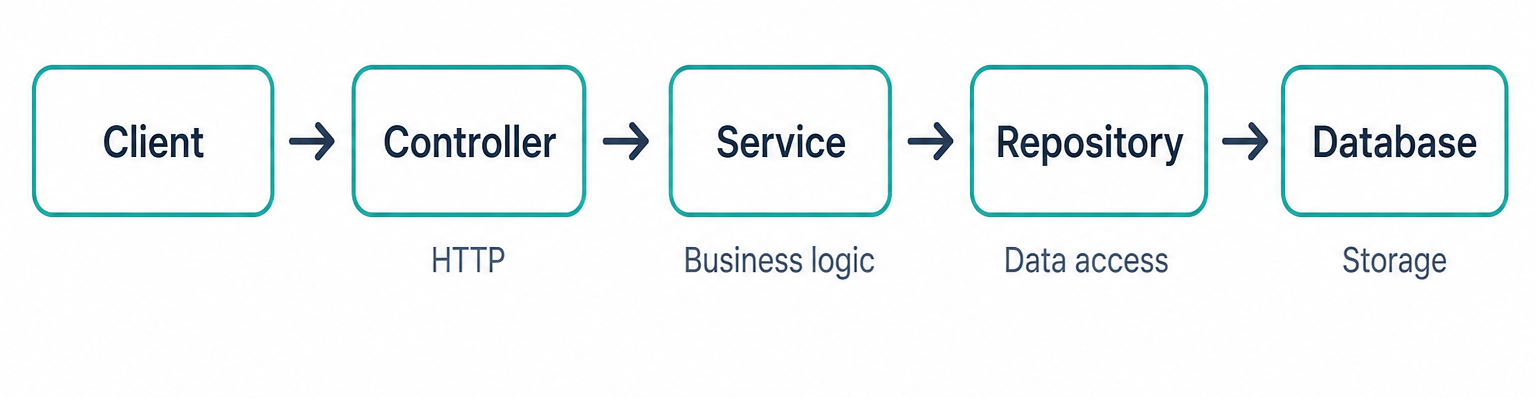
Why this matters technically: coupling drops between transport and domain. You can unit-test a service with a fake repository. You can add a GraphQL or queue consumer later that reuses the same service layer. You can also keep controllers thin enough that code review focuses on behavior, not HTTP plumbing.
If a function needs the raw request and response objects to make a business decision, it is probably in the wrong layer.
// Controller stays thin; service owns decisions; repository owns SQL.
async function getUser(req, res, next) {
 try {
 const user = await userService.getById(req.params.id);
 res.status(200).json({ data: user });
 } catch (err) {
 next(err);
 }
}
Middleware pipeline pattern
Express is a pipeline. Each middleware receives the request, optionally mutates it, then either ends the response or calls next(). Order is part of the design. Auth after business logic is useless. Error handlers registered before routes never catch anything.
A typical production order looks like this:
- Request ID
- Security headers / CORS
- Body parsing with size limits
- Rate limiting
- Authentication
- Authorization
- Schema validation
- Controller
- Global error handler
The exact order can vary by application, but the important rule is that authentication, authorization, and validation happen before business logic, while the error handler is registered after the routes.
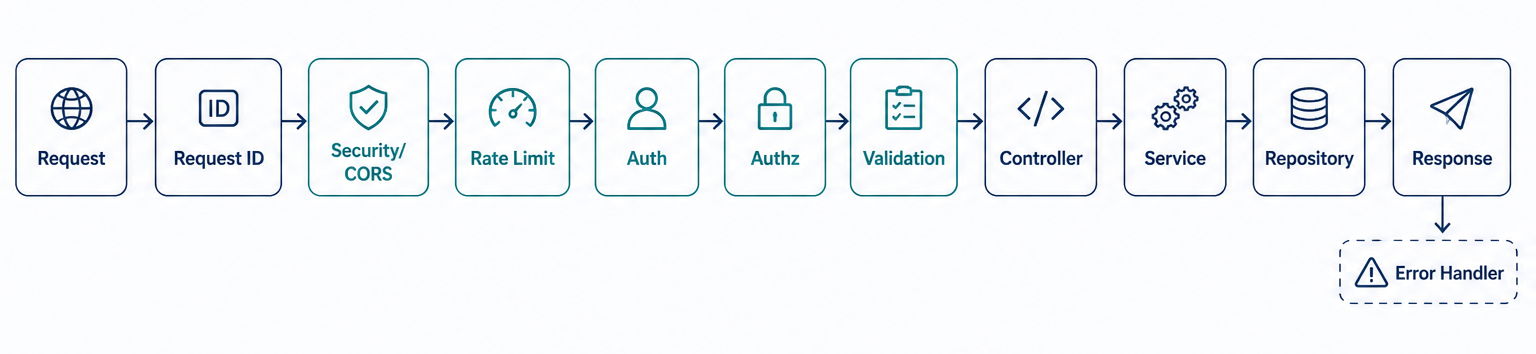
Middleware exists so cross-cutting concerns stay reusable. JWT verification, API-key checks, tenant resolution, and request validation should not be copy-pasted into every route. Attach identity once, then let controllers and services assume "who is calling" is already resolved - or fail early if it isn't.
Technically, this also improves observability. When every request passes through the same logging and request-id middleware, you can follow one call across services without each handler inventing its own correlation scheme.
Keep middleware narrow. A function that authenticates, validates, applies business rules, and writes to the database is not middleware - it is a god object with an Express signature.
Schema-driven validation
Never trust client input. Bodies arrive with wrong types, missing fields, unexpected nested objects, and query strings that are always strings until you coerce them.
Schema validation (Zod, Joi, Yup, or similar) pushes the contract to the edge of the system. You define what a create-user body looks like, what list-query params are allowed, and what URL params must be (UUID vs integer). Invalid requests should be rejected with a consistent 400 or 422 response before service code runs, depending on the API's error-handling convention.
That has two technical benefits.
First, services stop doing defensive field checks everywhere. Those checks duplicate the schema and drift over time. Second, coercion becomes explicit. A "20" from a query string can become number 20 at the boundary, so repositories don't silently compare strings to integers and wreck index usage.
Validate all three surfaces: body, query, and params. List endpoints fail as often from bad limit/cursor values as create endpoints fail from bad JSON. Validation belongs before business logic, not inside it.
import { z } from "zod";

const createUserSchema = z.object({
 email: z.string().email(),
 name: z.string().min(1).max(100),
});

// In middleware: parse req.body with the schema.
// On failure → ValidationError.
// On success → pass cleaned data forward.
Centralized error handling
Scattered catch blocks that each invent their own JSON error shape create client chaos. One endpoint returns { message }, another returns { error: "..." }, a third leaks a Postgres constraint string.
The production pattern is: throw structured errors from services, catch once in a global Express error middleware, map them to HTTP responses.
Operational errors (not found, conflict, validation, forbidden) become 4xx with stable codes like USER_NOT_FOUND or IDEMPOTENCY_KEY_REUSE. Programming errors and unexpected infrastructure failures become 500s. In production responses, hide stack traces and internal driver messages. Log the full error with the request ID server-side.
This is not just neatness. Stable error codes let clients branch reliably. Consistent logging lets on-call engineers search one field. And keeping HTTP status mapping out of services preserves the layered architecture - services describe what failed, the HTTP layer decides how to represent it.
function errorHandler(err, req, res, next) {
 const status = err.statusCode || 500;
 res.status(status).json({
 error: {
 code: err.code || "INTERNAL_ERROR",
 message:
 status >= 500 && process.env.NODE_ENV === "production"
 ? "Something went wrong"
 : err.message,
 },
 });
}
Idempotency for safe retries
Clients retry. Mobile networks drop responses after the server already committed. Load balancers and queues retry too. For reads, retries are usually fine. For creates, charges, and outbound calls, retries without protection create duplicates.
Idempotency means processing the same logical request more than once does not create extra side effects.
Teams usually combine two techniques.
At the API layer, clients send an Idempotency-Key on sensitive POSTs. The server stores the key together with a request fingerprint and the resulting response. The same key with the same request can return the original result; reusing the key with a different request should return a conflict. Keys should expire after a defined retention window appropriate to the operation.
At the database layer, unique constraints remain the last line of defense: unique external_payment_id, unique (tenant_id, client_reference), and so on. Application dedupe can fail under race conditions; the database constraint cannot be raced the same way if designed correctly.
This matters most for payments, telephony, webhook receivers, and any integration where "exactly once from the client's point of view" is a business requirement. "At-least-once delivery" is the default in distributed systems. Idempotency is how you make that safe.
Pagination, filtering, and query design
Returning unbounded lists is a latency and memory problem for both server and client. Production list endpoints always page.
Offset/limit is simple and fine for admin tools and small result sets. It gets expensive on deep pages because the database still walks large offsets, and inserts during pagination make results unstable.
Cursor-based pagination is often a better fit for large or frequently changing datasets. The client gets a cursor representing the last seen position (often an encoded created-at + id). The next query asks for rows after that position with a stable sort. New inserts don't shuffle earlier pages the same way offset does, and deep pages stay indexed seeks instead of huge offsets.
Filtering and sorting should be a documented allowlist, not an open expression language. Unbounded sort and filter parameters become injection surfaces and planner nightmares. Prefer explicit fields: status, createdAfter, sort=createdAt with a fixed direction convention.
Technically, pagination design is API design and database design together. If the API sorts by createdAt descending, you need an index that matches. If you filter by status and sort by time, a composite index often matters more than Node tuning.
Caching strategy
Caching reduces load when reads dominate and freshness rules are clear. It creates subtle bugs when writes happen and stale reads are treated as truth.
Common layers:
In-process memory is fastest and simplest, but each Node instance has its own cache. Under load balancers, users see inconsistent data unless TTL is very short or the dataset is truly static.
Redis (or another shared cache) is what horizontal scaling usually needs. All app instances see the same keys. You pay with network hops and operational complexity.
CDN / HTTP caching helps public or semi-static responses when you set correct Cache-Control/ETag semantics. Private user data generally should not be cached at the CDN layer.
The hard part is invalidation. TTL-only caching is acceptable for data that can be slightly stale. Inventory, balances, and permissions usually need immediate cache invalidation, careful write-through/write-around strategies, or no cache on the hot path. A useful rule: don't cache until you can explain what happens on update, delete, and multi-row list queries that include the changed entity.
Also cache at the right granularity. Caching an entire "dashboard aggregate" can be expensive to invalidate. Caching individual entities by id is often simpler and safer.
Security patterns every REST API needs
Security is layered controls, not a single middleware.
Authentication answers who is calling (session, JWT, API key). Validate the authentication mechanism on every protected request - for example, verify JWT signatures and expiry, validate API keys, or check the user's session.
Authorization answers what they may do. Role-based and permission-based checks should sit close to the action. "Logged in" is not enough for delete-user or export-all-customers.
Rate limiting protects against brute force and accidental self-DoS. Per-IP is a start; per-user and per-API-key limits are better for authenticated APIs.
Input limits and sanitization matter as much as auth. Cap JSON body size. Reject unexpected content types. Use parameterized queries exclusively. Treat query params as hostile input, not just bodies.
HTTP hardening includes strict CORS allowlists in production, secure headers (via Helmet or equivalent), TLS termination, and never exposing internal error details.
The guiding principle: the client is not a trusted peer. Even your own frontend can be scripted, replayed, or abused with a stolen token. Design the API as if every request might be malicious or broken.
Scaling patterns for growing APIs
Scaling Node APIs is mostly about architecture, not "make the server bigger."
Stateless app processes are the foundation of horizontal scale. If session state, upload temp files, or in-memory job state live inside one process, load balancing breaks. Sessions go to Redis (or similar). Files go to object storage. Any instance should be able to handle any request.
Horizontal scaling behind a load balancer then becomes straightforward: run N identical containers/processes. Node's event loop runs JavaScript on a single main thread per process, so multiple processes or container replicas can be used to take advantage of multiple CPU cores.
Load Balancer ↓ Node API · Node API · Node API ↓ Redis / Cache ↓ Database ↓ Job Queue ↓ Workers
Push heavy work off the request path. Email sending, CSV exports, media processing, and slow third-party calls should become 202 Accepted + job queue work. The HTTP request stays short, timeouts stay rare, and retries move into workers that are built for failure.
// Don't do heavy work in the request cycle - queue it and return 202.
const job = await exportQueue.add("user-export", {
 userId: req.user.id,
 filters: req.body.filters,
});
res.status(202).json({ data: { jobId: job.id, status: "queued" } });
Database performance is usually the real ceiling. Connection pooling, correct indexes, avoiding N+1 queries in list endpoints, and separating read-heavy traffic when needed matter more than micro-optimizing Express middleware.
The key idea: keep the request/response cycle boring and fast. Anything that can take seconds belongs in asynchronous processing.
Observability: logs, metrics, and traces
You cannot operate what you cannot see.
Logs tell you what happened on a specific request. Prefer structured JSON with request id, route template, status code, latency, and user/tenant identifier when appropriate and safe to log. String-concatenated logs don't search well under volume.
Metrics tell you how the system behaves in aggregate: requests per second, p95/p99 latency, error rate per route, queue depth, cache hit ratio. Metrics catch regressions after deploys before users open tickets.
Traces tell you where time went across API → database → cache → worker. When p99 jumps, traces show whether the spike is SQL, Redis, or an external HTTP call.
For each important endpoint, track traffic, latency, and errors. That triad is enough to spot a missing index, a bad release, or a dependency outage. Logging alone without metrics leaves you reactive. Metrics without request ids leave you unable to debug a single customer failure.
Production readiness checklist
Before calling an API production-ready:
- Stable resources, methods, and response envelopes across endpoints
- Clear controller / service / repository boundaries
- Schema validation on body, query, and params
- Centralized error mapping with stable codes and no prod stack traces
- Authentication and authorization on protected operations
- Rate limiting and request size limits
- Idempotency or uniqueness for create/payment-like side effects
- Pagination on every list endpoint
- Caching only where freshness and invalidation are defined
- Structured logging plus latency/error metrics
- Heavy work moved to background jobs
- Database indexes aligned with real filter/sort patterns
A production API is not merely functional. It stays predictable under retries, readable under failure, and boring enough that other teams can build against it without constant clarification.